
Live-Edge and Epoxy: Inside Ole Wood Shack’s Custom Furniture Success
Ole Wood Shack involves clients at every step, from slab selection to videotaped epoxy pours.
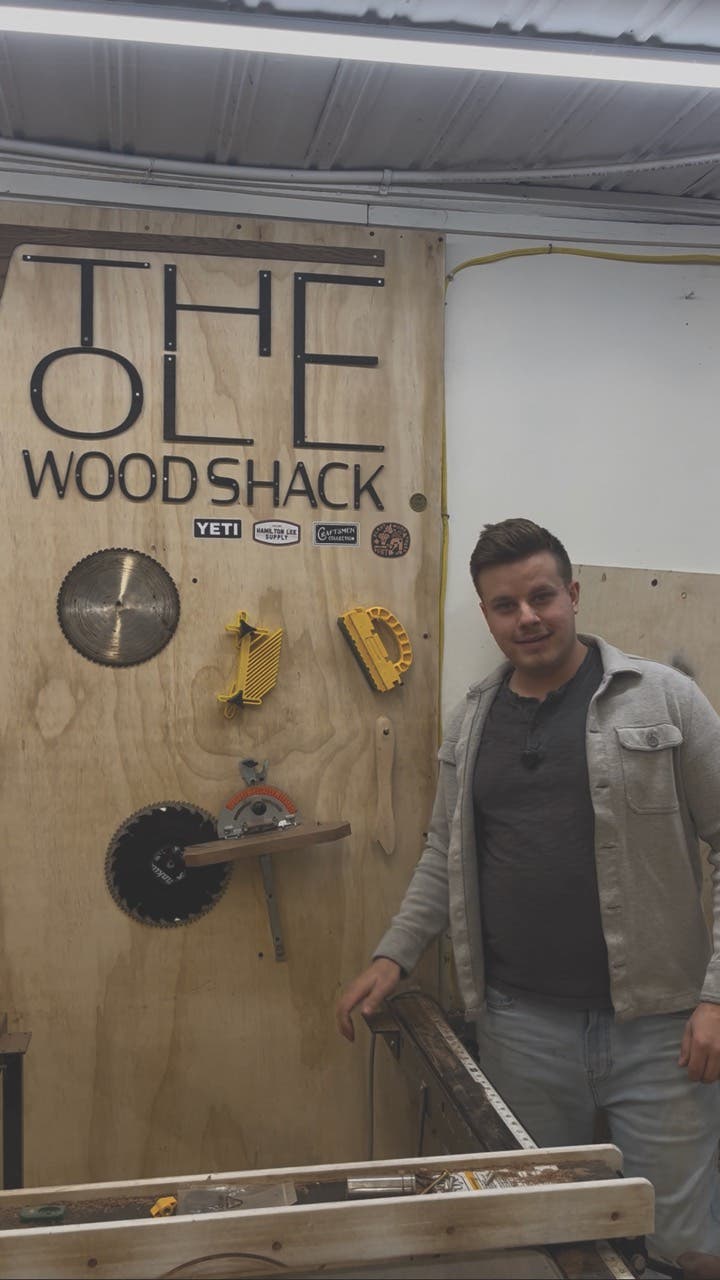
Bradlyn Zimmerman of the Ole Wood Shack in Pleasant Hall, Pennsylvania, just outside Harrisburg, offers custom furniture with live edge and river tables as his signature products.
Zimmerman started the business in 2020 after years working in the woodshops of his father and uncle. Drawing on that background, he built a company centered on craftsmanship and customer experience — an approach that has proven successful in the growing market for bespoke furniture.
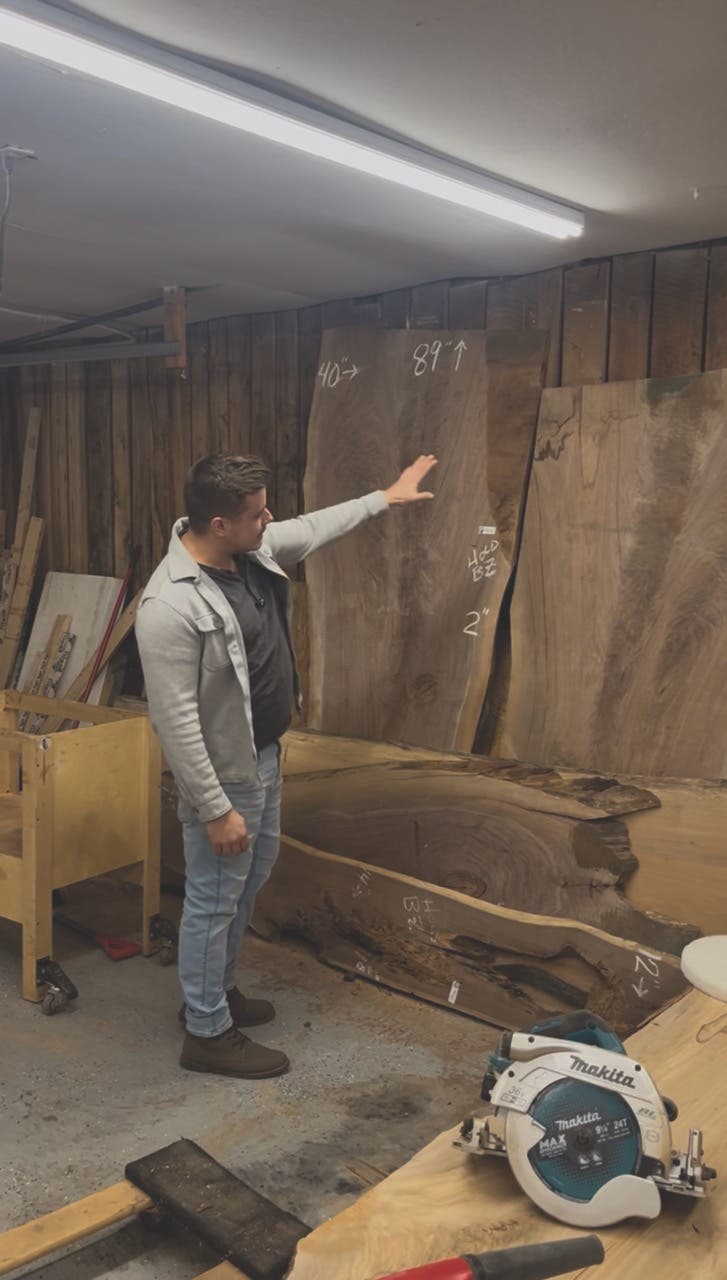
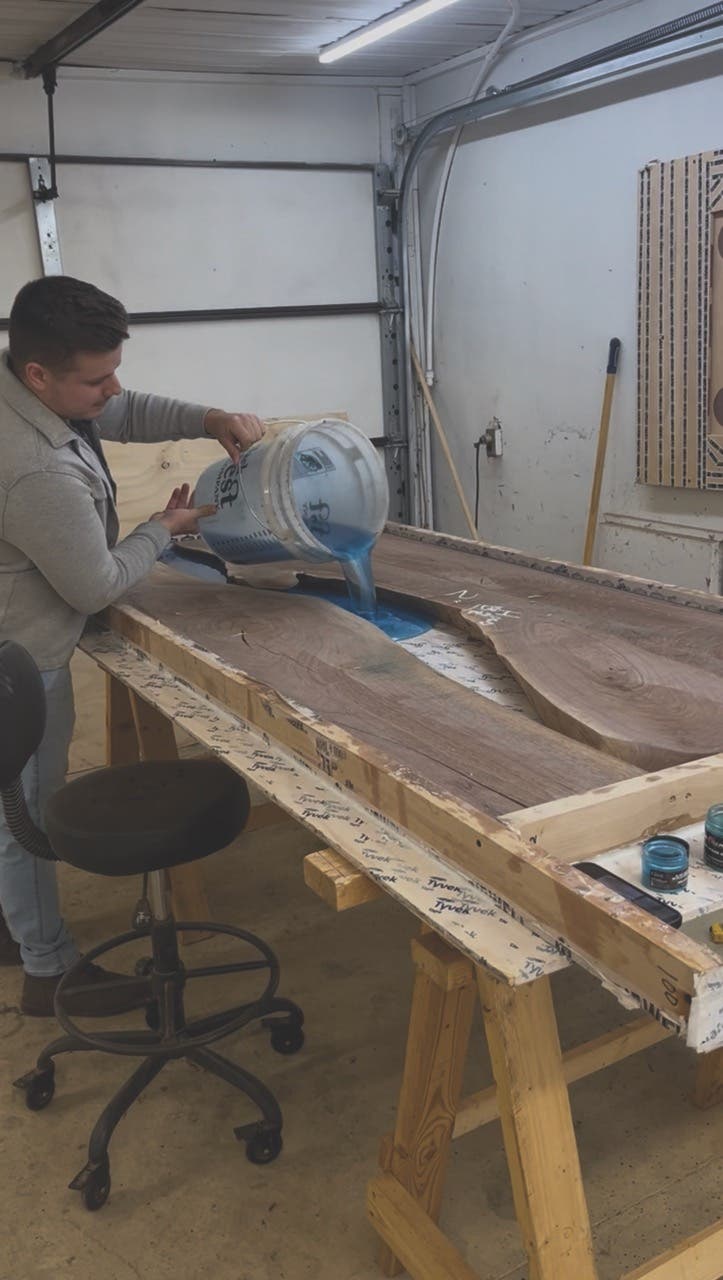
“That’s one thing that sets us apart from just going to the store and buying something,” Zimmerman says. “When clients come to us, we keep them updated through every step of the build. Through the slab selection they can pick the exact slab they’ll be using in their table and when we do the epoxy pour, we always video that for them so they can see the epoxy part going in, and all the other steps in making the table come to life.”
Zimmerman has shared his experience with the broader woodworking community. In 2022, he authored “Building Wood and Resin River-Style Tables,” a step-by-step guide published by Fox Chapel Publishing.
Working mostly solo, with occasional help from his father, Zimmerman operates from an 1,800-sq.-ft. four-bay garage on his property. The shop is divided into two sections: one for rough milling and another for assembly and finishing work.
Trial and error
Zimmerman’s journey into river tables began as a side project while working in his father Tim’s woodshop. Tim’s business primarily produces handcrafted solid wood chairs for Zimmerman Chair, a wholesale furniture manufacturer in Lebanon, Pennsylvania, owned by Tim’s brother. Around 2010, the father and son team started making live edge tables alongside their chair production.
Over the following decade, Zimmerman experimented with extra wood in the shop, making floating shelves, coffee tables and other small pieces. He gradually taught himself how to work with epoxy resin, learning to mix, pour and cure epoxy before developing the confidence to turn the craft into a business.
“With the live-edge, I like the custom aspect of it. It’s unique,” he says. “I enjoyed making the chairs, but we were doing large batches of chairs like 20 or 30 at a time, so there were times you’re just working on one part of them. You’d have a box of 200 legs, and you’re just working on legs. It could get monotonous. I enjoyed it, but I started doing this on the side.”
Nationwide clientele
Four years after launching the Ole Wood Shack, Zimmerman’s work now reaches clients throughout the U.S., with projects shipped from California to Martha’s Vineyard. Most clients are in the Northeast, particularly New England states down to Virginia, and are primarily homeowners looking for one-of-a-kind builds.
“The clientele is generally all over the place. Mostly higher income people looking for something like a dining room table they can’t just buy anywhere else,” Zimmerman says.
He relies heavily on Google advertising and his website for leads, along with referrals and word-of-mouth recommendations.
“They want something you can’t find in a store, and something where you can customize every aspect of it,” he says. “When the order comes in, they tell me all the things they would like or not like with the slabs, then I take pictures of each slab, and will start with pictures of six or seven slabs, so they are actually picking their piece.”
Commercial projects have become an important segment of the business.
“I would say we do around 20 percent commercial. It varies a lot every year,” Zimmerman says. “Our main purchases in the commercial world are conference tables, and we also do some for restaurants, casinos, that sort of thing. Law offices are very popular for conference tables.”
Challenges of river tables
Although epoxy river tables have surged in popularity in recent years, the process remains technically demanding. One of the biggest challenges is ensuring accuracy, since each slab is unique.
“If you have to go and get another slab, there’s no way you’re going to recreate what the customer had planned for. You don’t get a second chance,” Zimmerman says. “You need to be careful with your finishing, and make sure the slab remains flat and nothing warps on you. With the slabs, you only get one shot with each piece.”
The process begins with flattening the slabs. Zimmerman uses a custom surfacing machine made by Pennsylvania-based JointaWood.
“The slab surfacing machine is important — this makes your slabs flat, which is the very hard part in slab work,” he says. “Some people run their slabs through a wide-belt sander, but if your slab already has a bit of a twist, it will kind of just run through it and still have a bit of a twist.”
The machine features a 12-inch helical planer and a 12-inch drum sander. Pieces receive a first pass, and if there are gaps, shims are added before running back through. A jointing router is attached for machining book-matched slabs.
Once slabs are flattened and prepared, attention turns to the epoxy river itself.
Mastering epoxy
Working with epoxy resin requires careful preparation and attention to detail. Early in his career, Zimmerman learned this lesson the hard way.
“One of the first river tables I made, it leaked all over the floor. There were gallons and gallons of it,” he recalls. “We got it done, but there were not many videos on YouTube yet, now you look on there and there’s lots of information on it.”
Properly constructed forms are essential for successful pours. Zimmerman builds his own forms, and the key, he says, is to make sure the epoxy doesn’t stick once it cures.
Zimmerman uses EcoPoxy Flowcast resin and hardener.
“It’s more of a sustainable epoxy and I’ve worked with it for years,” he says. “Epoxy is one of the things you’ve got to know how it works in different temperatures and kind of get a feel for it.”
Preparing the epoxy involves adding pigments to achieve the desired color.
“The hardest part is knowing what shades to mix together to create that look, because the powder that you see looks a little different when it’s wet,” he says.
Two-stage pours are essential to prevent overheating during the curing process. Half is poured one day and the remainder the following day. The table is left to cure for about a week before the forms are removed.
“After that you pretty much work with it like wood. You plane it, you sand it,” Zimmerman says. “Obviously there’s a few differences that you have to be careful of but in general you work with it as if it was wood.”
River tables typically weigh 400 to 500 pounds, with some conference tables exceeding 1,000 pounds. Zimmerman says handling pieces requires planning and special equipment like forklifts.
A refined direction
Zimmerman says the company has experienced ups and downs as economic conditions shift. The first two years saw rapid growth, followed by a temporary slowdown.
“I would say we’re getting a lot more higher end projects than when we started out; people have seen what we’ve done,” he says. “We’ve done well over 100 tables now.”
Looking ahead, he hopes to expand further into high-end commercial projects and designer collaborations.
“We’re looking for interior designers more. Right now, we’re doing several conference tables, so we like to work with designers,” Zimmerman says. “The goal is to work in the commercial world a bit more with designers on larger projects.”
As part of that strategy, he’s rebranding the business under a new name.
“We’re transitioning the name to Vestige Furniture Studio,” he explains. “The current name I started off with when I was making shelves, bowls, or trinket pieces like that, and then the business just kind of grew into tables. We want the name to more correctly represent the high-end luxury work we currently do.”
Learn more at theolewoodshack.com.
Originally published in the May 2026 issue of Woodshop News.