
Veneer made simple
A shop‑friendly guide to working with veneer, covering the grades, terminology, types and more
Beyond the fact that it’s a renewable resource, there are several design and budget reasons to use veneer. On a plywood or MDF core it’s relatively insusceptible to expansion, contraction, warping or splitting. Veneer can deliver the look of an expensive hardwood, or a more costly cut such as quartersawn or rift, at a lower price. And it offers a woodshop design choices such as book-matched or sequenced panels.
The first step in working with veneer is to decide whether to lay up panels in the shop or buy veneered sheet goods. Those can be full sheets or cut-to-size, which costs more per square foot but saves shop time. Smaller panels are also easier to load on a CNC or table saw and move around the shop.
Grades of veneer
When ordering custom panels, keep in mind that there are different grading regimens for raw sheet veneer as opposed to a product that has already been laid up on substrates.
Veneers on ply, MDF or lumbercore/blockwood are graded four ways. The best is A, which is essentially knot-free and has a sanded surface that will require very little processing before coating. B can have a few defects and even some repair patches, but it’s still a high-quality grade. C can have defects such as filler, knots, and discoloration that can work for a more rustic project, but not high-end cabinetry. D is a good choice for balancing veneer on the back of a panel where a premium grade has been used on the front. It imparts a measure of physical equilibrium and helps moisture move through both faces at about the same rate.
For shops that want to lay up their own panels, buying veneer in rolls or sheets can involve a different set of grades. AA is premium that’s virtually clear, while A or Custom can have a few minor imperfections. AA is sometimes called Select because it is selected for both grain and color, while A can be called Uniform when it’s matched for color only. Next up is unbacked B/BB, which has a high-quality face and usually a slightly less desirable back. There’s a ‘best’ face, so the woodworker needs to orient this veneer correctly. BB/BB veneer is going to have a decent quality on both faces, so it’s often used in applications where it isn’t showcased, such as the back of a door or the inside of a cabinet. Again, certain rustic designs like to highlight minor flaws, so BB/BB can be a cost-saving choice on jobs such as panels in 5-part rustic hickory doors. And a BB/CP veneer grade means that one face of the veneer is quite high quality while the other can be significantly less desirable.
Columbia Forest Products has an impressive Veneer Species Guide on its website, columbiaforestproducts.com, that displays common cuts for each species along with its uses, a cost guide, where it comes from, and characteristics.
Terminology
Some mills call a veneer with both heartwood and sapwood a ‘natural’ veneer. Others bypass the grade system altogether and use descriptive words to differentiate among choices. In those cases, select veneers are going to have all heart or sometimes all sap, and a select flitch may be available that has sequential matching. A flitch is basically a stack of veneer sheets (called leaves) that all come from the same log, and if they’re saved in the order they fall, then the woodshop can build wide expanses of cabinetry with a uniform, organized look.
A cant is a log that has been squared, and in the veneer mills these are used to create sheets that don’t have bark and might not have any sapwood, but they do have relatively straight edges.
Thin veneers (less than 2mm or 5/64") are great for curves, but they can be quite delicate, even when backed with paper, and they’re also easy to sand through. Medium veneers (2mm to 4mm, or 5/64" to 5/32") are a little less manageable around bends and curves, but they can offer a deeper, more vibrant and durable finish because the coatings have somewhere to build up and soak in. Thick veneers (above 4mm or 5/32") may show a line at joints and corners if the grains differ, but generally if two pieces meet with the same grain direction, that’s not a problem. Superior Veneer & Plywood (superiorveneer.com) offers an Artisan line of veneers that are 1/16" thick and come in many species including kahya (African mahogany), sapele and anigre, and with a variety of backing options.
In larger shops and mills, slicing layers of veneer to create matching edges for laying up wide panels is done on splicing machines. In small shops, it’s often done by stacking the edges and using a knife or a veneer saw.
Veneers can be raw, laid up, backed or reconstituted. Raw veneer is just a thin slice of wood. A laid-up veneer is a sheet made up of several narrow strips to create a larger, more usable product. This involves cutting two edges at once so they will line up perfectly and then securing them with veneer tape on the appearance face before adhering the other face to a substrate. Backed veneer has traditionally had a paper backer, but nowadays it can be cloth or film. For example, DC Distributing (dc-dist.com) is a major supplier of edge banding that offers veneer sheets with a paper backer in 5, 10, 20 or 30 mil thicknesses, and also with 3M pressure sensitive adhesive or a phenolic backer. The company also offers book, running, slip, plank, center and balance matched veneers.
Certainly Wood (certainlywood.com) carries raw wood, full-length veneers from approximately 1/50" (0.02") to 1/42" (0.024") thick, plus a selection of special thickness veneers.
Northwest Lumber in Indianapolis (northwestlumberco.com) sells paperbacked 10-mil veneers and edge banding in more than a dozen species in 24" x 96" sheets, plus maple and cherry in 48" x 96" and ebony and wenge in 48" x 120". Northwest also offers 250’ rolls of 7/8" and 2" wide pre-glued iron-on tape, which can also be ordered by the foot.
Decore-ative Specialties (decore.com) offers two-ply phenolic backed veneer sheets in various sizes and species that have two layers of perpendicular cross-grain veneer, and this allows it to bend somewhat in either direction. Phenolic backing is an impregnated plastic-like resin, similar to the back of plastic laminate.
EdgeCo (edgecoinc.com) carries more than 50 species of wood edge banding for iron-on or hot air applications, from alder to zebrawood. For shops looking for wider banding, this company will slit to width from master rolls. The tape is fleece-backed and finger-jointed.
Reconstituted veneer is a take on an old cabinetmakers’ technique, where thin slices of wood are laminated together and then turned ninety degrees and sliced. WalzCraft (walzcraft.com) explains it thus: “Reconstituted Veneer is a man-made product using a fast-growing tropical wood species, often Obeche. Veneers are dyed to mimic the look of a particular species and are constructed by laminating a block of veneers together. The laminated block is sliced so that the edges of the laminated veneer become the “grain” of the reconstituted veneer”. The result looks like quartersawn grain.
Tear-out and other challenges
Some suppliers can deliver pre-finished veneer edge banding, which can be a big timesaver. For example, prefinished veneer coils from Edgemate (edgemate.com) can be ordered with a PUR-UV clear lacquer finish in a full range of gloss levels, and these can be custom stained to match virtually any real wood.
Woodshops with a CNC use compression bits (down spiral for the top of a sheet and up-spiral for the bottom) on sheets that have veneer on both faces. But in shops without a CNC, there are still a number of ways to reduce tear-out on the table saw. Some manufacturers make veneer-specific blades, but if that’s not an option, then a sharp, high-quality, 80-tooth or higher blade can work well. A table-saw with a scoring blade is the best choice, but if one isn’t available then an old cabinetmaking trick is to raise a fine blade just above the table (about 1/8" exposed) and ‘score’ the bottom face before raising the blade to make the complete cut. A zero-clearance insert and blue painter’s tape on the bottom face of the panel along the cut line will also reduce tear-out.
Another option for short runs is to attach a sheet of inexpensive 1/4" plywood to the expensive veneered panel using blue tape and let this face slide across the table. Laying a straightedge along the pencil/cut line and then scoring with a sharp knife through the veneer before running the panel across the table saw can help, too. It reduces resistance along the kerf line.
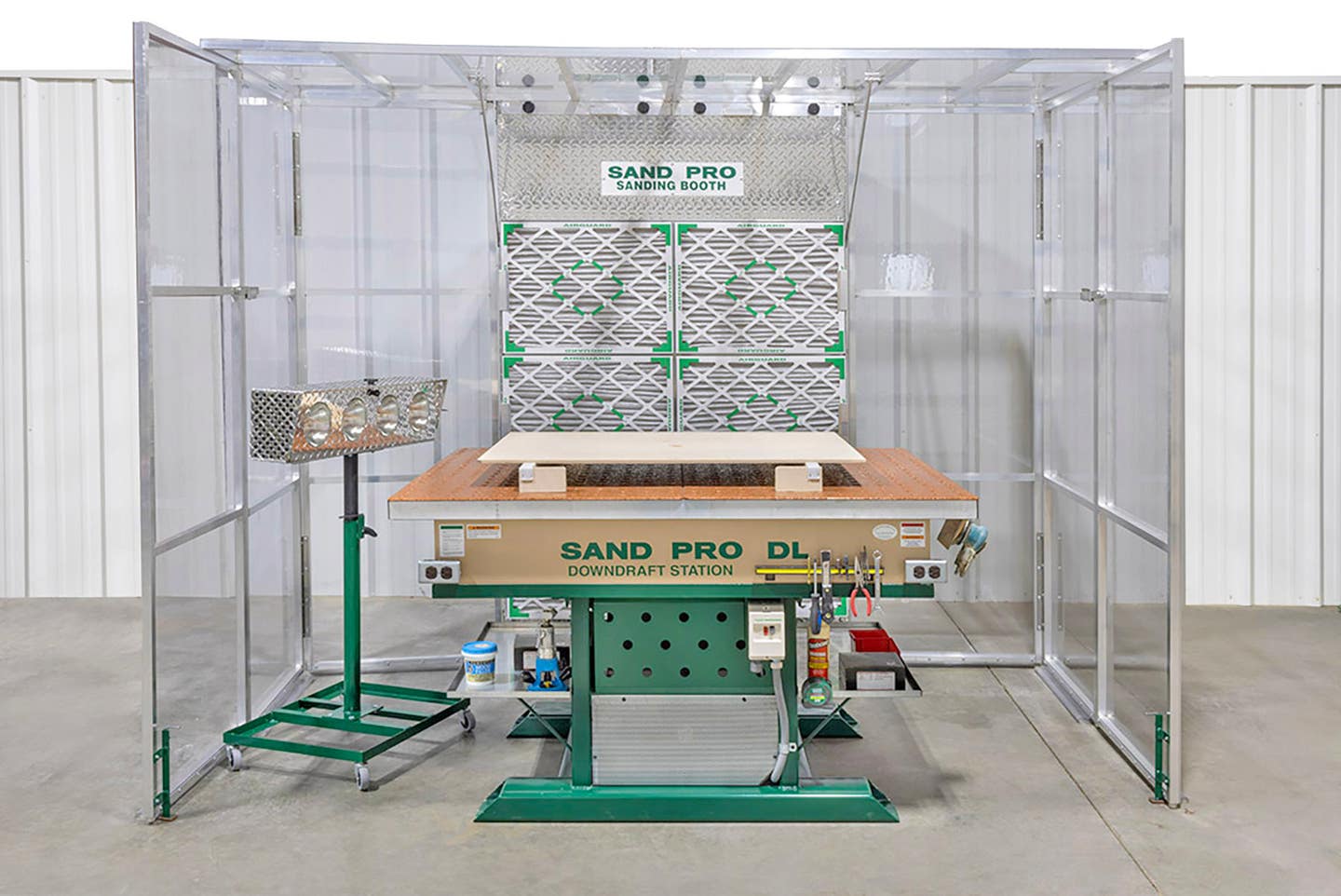
Sanding veneer panels can be tricky — 5/64" on thin veneer doesn’t leave much room for mistakes. The multiple head 23 series of wide belt sanders from Timesavers (timesaversinc.com) is one of the most common answers to this challenge, as it has the ability to provide a very gentle and well-controlled touch. The manufacturer suggests passing the substrate through the machine first, before applying the veneer.
Veneers come either raw, or with pressure-sensitive adhesives, or with heat-activated glues. For raw lay-ups, it’s a good idea to use an adhesive recommended by the veneer manufacturer for specific backers. Some professionals steer clear of contact adhesives in favor of glues that aren’t so hard and brittle after curing, but this can be a good solution on small panels. And buying in pre-glued edge banding can save a lot of time. Matching species, even unusual ones, is relatively easy. For example, CabinetParts.com (cabinetparts.com) lists about 100 species, including hard-to-find cuts such as quartersawn walnut and rift sawn white oak.
Among the machines available for commercial veneering are cross clippers, fanners (they prevent veneer strips from sticking together after the glue is applied), gluers, specialty saws, guillotines, and splicers. Vacuum clamps are the industry standard for shaped parts, and pressure clamps are often preferred for flat sheets. Small shops may use a vacuum clamp for both. A vacuum bag conforms to the shape of the strongest or most resistant shape, which is the substrate, and forces the more flexible veneer to bond evenly.
Felder Group USA (felder-group.com) recently introduced the new MVP 31.14 flex, which is a membrane vacuum press for shape gluing. It has a small footprint and can handle large and tall workpieces. It has stopped grooves in the table that guarantee uniform pressure, and this machine works fast because it has a powerful 40 or 48 m³/h (60Hz) vacuum pump.
For shops that are veneering more than occasionally, Evans Midwest (evansmidwest.com) offers machines for panel lamination, feeding, cleaning, gluing, stacking, and roller pressing. The company’s glue spreaders, laminate racks, layup tables, and roller presses can be customized.
Larger shops building larger parts such as veneered passage doors or wall panels might look to continuous cycle presses such as the Sergiani Las from SCM Group (scmgroup.com).
Small shops that need to attach real veneer to the edges of panels often use a household iron and a tape with hot melt adhesive. A step up is a small edge bander, such as the EP-C or EPC-3 from Adwood (adwood.com), both of which can handle curves.
Looking forward, the way we think about natural veneer is being challenged by technological advances. For example, REHAU’s Rauvisio Ingrain (rehau.com) is a wood fiber laminate that is made with cellulose fibers from wood pulp. It’s etched for a natural feel, and costs about one-third the price of pre-finished veneer. And Lenderink (lenderink.com) has launched a new product, Expandable Film Adhesive, that’s a heat-activated foam core composite. It fills a mold cavity to form parts of any shape, without the need for time-consuming machining processes or costly press equipment, so a shop can make veneered and shaped panels that are both lightweight and strong.
Originally published in the December 2025 issue of Woodshop News.